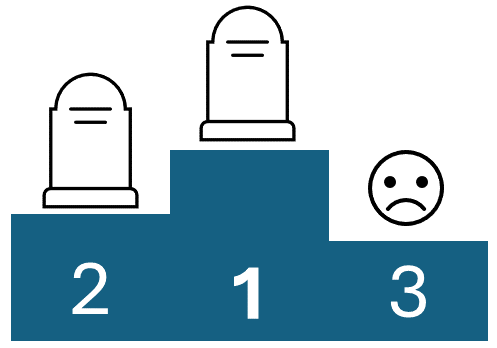
“Sports are healthy” is a myth that persists in the public’s mind. That is barely true for the average person1. It is definitely not true for performance sports. On the contrary, sacrificing your body is part and parcel of the process. More importantly they will choose to long term injury to achieve short term glory2. The drive to succeed is what differentiate high end athletes from the pack. Once you understand this point, another pitfall shows up: the “driven person”. The idea that someone will succeed on everything due to their internal drive is also pernicious. Those people are so rare to not be real, every other person has only enough of that single-mindedness in one topic. Simply, being good at something does not make you good on another3.
Summer Olympics examples
This year there have been a large number of examples of how this drive affect athletes and their decisions. The Olympics are the showcase of glory over health. I’ll take a look at these examples and wonder if there’s something that could be done on an organizational scale.
1. Noah Lyles races the 200m final with COVID
Noah Lyles won the 100m race in the Paris Olympics earning the title of “Fastest Man in the World”. His next race was the 200m, previously his best event. Lyles finished in third and collapsed shortly after the race and was moved out in a wheelchair. In a matter of minutes, it became public that he had COVID, with symptoms and that he had “coughed through the night”. The immediate question is: should he have raced? I have no doubt that he was always participating unless someone interfered4.
Was it a public health risk? Assuming that the low risk transmissions outside, vaccine availability5, plus the brevity of the race and precautions before and after made it a relatively low risk to have him there.
Should the other athletes (and the organizers) been told? To me, this is more an ethical question. I don’t think any of the finalists would pull out of the race. The optics would be bad for the Olympics, especially if one of the other athletes said anything.
The last question, and in my opinion the most important, should he be allowed to risk his life? A crucial part of this consideration is the fact the Lyles is asthmatic and he cannot use steroidal drugs for it. The inherent high risk for him combined with the exertion of the sprint itself could have led to cardiac arrest. Is that risk high enough? Should it be left to the individual? Does the event have any responsibility? In the end, the Olympics approach to COVID was to pretend it did not exist6. In the end, leaving the decision to athletes is the same as allowing them all to compete. Very few would pull out and frankly it is surprising when it happens.
2. Vinesh Phogat fails to make the weight
Vinesh Phogat is a Indian wrestler who has competed in three wight classes (48, 50 and 53 kg). In the 2020 Olympics, she entered as the number one wrestlers at 53 kg7. The following year (2022), she won the gold in the Commonwealth Games and the bronze in the World Championships. However, in Paris, she competed at the 50 kg class, and despite making it to the finals, was disqualified due to weighing more than 50 kg in the day of the final.
There a few things to consider on the rules that forced Phogat to participate in a lower weight class than her normal one. First, there is a one-athlete limit per nation in any given event. A different Indian wrestler (Antim Phagal) qualified first for the 53 kg class. The circumstances of that are controversial, Phogat was at odds with the Indian federation and suspended when the qualifying event happened. Second, there are fewer weight classes in the Olympics compared to the World Championships8.
Hence, Phogat needed to qualify at a different class and her only realistic options were to go up and compete at 57 kg or down to 50 kg. Competing at a higher class, especially one that is 4 kgs higher and that combines the 55, 57 and 59 kg wrestlers is a terrible idea. Competing at 50kg, meant cutting more weight than normal. She qualified and in the Olympics made the weight on the preliminary rounds and only failed in the finals morning by a decimal.
Eating disorders and dubious weight management practices are fairly common in fighting sports. The weight classes exist to protect athletes from unfair pairings but it creates bad incentives for fighters to participate in weight classes that are lower than their daily weights. Cutting weight the day before and day-of the weighings are common at all levels of competition. They include, not eating or drinking, varied ways to sweat profusely and purging. Commonly as they get older, the ability and the will to cut is lower and fighters move to higher weight classes. Phogat was at the end of her career9 and 53 kg is the highest class she had ever been in. On the other hand, skipping her last chance to participate in the Olympics is not really a consideration. Her decision to compete at 50kg is then pretty obvious.
What could have been done to avoid this elimination? Making the weigh-ins on the first day only could have helped but it creates an even crazier situation where larger athletes would enter and fail to cut before the event even started. Have more weight classes might have helped, maybe Phogat would have competed at 55 kg but I seriously doubt it.
Next, is it fair to disqualify her and move her to last place? Phogat made the weight in every other day and won her matches. Should the disqualification only have removed her from the final itself, awarding her the silver and the gold to the other finalist and eventual champion Sarah Hildebrandt. I’m inclined to agree with this move. However, if the rule is meant to discourage athletes form ever risking missing the weight, the punishment has to be this hard.
3. Canada soccer drones
On the other side of the reasonable spectrum, we have team Canada using drones to spy on other teams. It is a much more clear case of cheating but also a basically useless information gathering. But leaving any edge out is anathema to competition so I understand. Sometimes you have to help people help themselves by forcing them not to do something stupid10.
4. Women’s Floor final
A quite different case is the controversial final for the Women’s Floor event. Romanian gymnasts Ana Maria Bărbosu and Sabrina Maneca-Voinea initially placed third and fourth. Team USA appealed the score given to Jordan Chiles and on appeal moved her up to third place. Judging mistakes happen, appeals are part of the rules and making use of them is part of the fabric of the competition.
The issue arises when some mistakes can be appealed and others can’t. A very clear mistake was made on Voinea’s score where she was given a penalty for going out-of-bounds when she never did. Suddenly, the final became a case where depending on rules lawyering three different gymnasts would win the medal.
That the subjective error (Chiles difficulty score) is reviewable and the objective error (Voinea being out of bounds) is not is patently absurd. Beyond that, it is clearly out of the athletes control, they have to compete with whatever the rules are. Abusing the rules is part of the competition but it is not in the spirit of competition. This is where the drive athletes have come into play. Of course, they will compete no matter the rules. Of course, those who can appeal will do so11. There will be rounds and rounds of appeals and judgements. In the end, a judge will make an arbitrary decision that can only hurt the athletes.
I have previously written about my distaste with reviews and the monetary thumb on the scale12. It is no surprise, that I believe that the original result should stand.
Translating to other fields
My current work in academia shows repeatedly how drive can separate those who graduate and those who drop out. Mastering out of a PhD program is fairly common. It is in some places a built-in escape route for underperforming students.
The biggest mistake outsiders make when discussing academia, especially a PhD, is the assumption that intelligence is crucial. It simply isn’t, there are many idiots with degrees out there. In a broad sense, access is the limiting factor. There are intelligent, curious people everywhere, they simply don’t have a way to make it to college much less graduate school. Assuming you have the access, the net important thing is how much you want it.
Graduate school is grueling, boring and pays poorly. Anecdotally, everyone ends up traumatized one way or another. The people that finish, are willing to sacrifice their health (mental and otherwise) to achieve. It is not a value judgment, it is possible that the right choice is to leave. It is also the reason why academia has so many egotists, psychopaths and plain old stubborn people.
The comparison of PhDs with Olympic athletes is not particularly apt at first glance. They are in many ways both at the pinnacle of their fields. A PhD is one of the dozen (maybe dozens) of the best people in any given thing much like Olympic athletes. There are other similarities – access being the greatest barrier for example. American athletes are on the high end of glamorous version. Getting a PhD is more akin being a tennis player from Latin America. You make no money, probably will get your ass kicked in every match but no one can deny you are an Olympian.
If you are wondering if graduate school is for you, the question is do you want it hard enough?
The system should probably change to protect students. Reducing power unbalances would be a great improvement. However, the problem remains that there are people that will sacrifice their bodies, their minds and/or their souls for something. That something may not be valuable or knowable to you does not change the fact it is still desirable for someone. All that means is that you don’t have the drive to achieve it.
- Weekenders, i.e. people that only play sports on the weekends, have higher heart failure risks. ↩︎
- Glory is broadly defined. It might be as low as entering a competition that you have zero chance of winning when healthy. ↩︎
- Hi Tom Brady. ↩︎
- After the 200m final, he did not participate in any events including the relays. ↩︎
- This is the diciest argument, vaccine availability is not equitable and puts people at risk in poorer countries like many sprinters even if the athletes themselves are vaccinated. ↩︎
- More than 40 athletes tested positive and were allowed to compete. Adam Peaty, an English swimmer swam the 100 breaststroke final; Lani Pallister, an Australian swimmer withdrew from the 1500m freestyle. An outbreak hit the Australian women’s water polo team. ↩︎
- She lost in the quarterfinals. ↩︎
- 50 kg, 53 kg, 57 kg, 62 kg, 68 kg and 76 kg for the Olympics. 50 kg, 53 kg, 55 kg, 57 kg, 59 kg, 62 kg, 65 kg, 68 kg, 72 kg and 76 kg for the World Championships. ↩︎
- She retired after the Games. ↩︎
- A similar scandal happened in College Football, where University of Michigan assistant Connor Stallions “stole the signs” from opponents. The information is more valuable in football than in the drones were gathering but it is also an accepted practice as long you are not caught. ↩︎
- Making your own fake medal is pathetic though. ↩︎
- https://bigcatgod.com/2024/02/09/it-is-ok-to-not-love-the-sport/ ↩︎
 Big Cat God Productions